
This will be series of posts, tracing my efforts to brush up and improve my knowledge of quantum computing. I’m not going to write (rough) copies of quality contents already widely available online to learn the topic; instead I’m going to record which resources I have been using: that’s why I decided to name it “an opinionated path”.
As every subjective contribution, it makes sense to draw the context: given we are speaking about revamping knowledge, for sure it matters where I come from, my relevant background: I’m a telecommunication engineer, I almost attained a B.Sc. in physics as well, and I’m interested (as you know if you follow this pages) in cryptography. I don’t want to say that two degrees are mandatory to approach the QC field, but for sure previous knowledge drives the approach: in my case I enforced:
- my analytical and keen mindset: you haven’t to be a genius, but for sure you have to be motivated to work hard now for a maybe-and-definitely-not-granted future outcome: so you have to study that stuff just because you like it, without thinking to any easy target (even if now there’s a lot of hype… btw, the “demystifying part” of why I’m writing this post);
- geometry and linear algebra (eigenspaces, bases, the d@mn many product types, …): quantum concepts can become harsh, and certainly they often are non-evident. A solid, safe harbor given by matrices stuff is a good parachute;
- bra-ket notation: you haven’t to be an hydrogen energy levels master (at least if, like mine, your target is “how to compute with QC” and not “how to build an actual QC”), but abstract state notation is the ABC to deal with qubits’ finite-dimension Hilbert space (and well embracing matrices harbor);
- error correction codes smattering: a “good” quantum error correction is THE enabling factor, the cutting-edge research is about that and knowing classical foundations is a big help;
- computational complexity: one of the most promising uses of QC is cryptanalysis, so the expectations are stated in terms of how much QC is faster than classical elaboration
As you perhaps have understood by my previous words, we are dealing with a very very multidisciplinary field: of course almost noone can be an everything-super-expert, but having an ACTUAL widespread knowledge is a sufficient starting point. Remember: keenness and foundations.
All that said the first place to start is IBM Quantum Experience documentation: if I remember correctly I began to play with the simulator in 2016, and I can witness that documentation changed many times, embracing more and more applications at every change, but imho losing its didactic value. I still have an old 2.0 version of that tutorial, PDF-ized from web site pages:
It brings you from the very basics with qubit’s Bloch sphere representation to advanced topics as Grover, Deutsch-Jozsa, Bernstein-Vazirani, Quantum Phase Estimation, Shor’s algorithms; during the path you see gates, measurements, entanglement and last pages are dedicated to some hints introducing error corrections. It’s divided in two parts, an opening beginners guide and a following full one. Even if written as a tutorial it isn’t an easy reading: I suggest you to be careful to every words; verify what you read making gates composition calculus as self-imposed exercises; find typos (yes, a few are present); don’t accept anything you are not understanding because it often means there are deeper concepts you have to make more explicit than the way the are expressed, especially in late pages dealing with more complex algos.
I’m not an LLMs fan, but I have to say that they are useful studying assets given their ability to explain obscure passages: in specialized web spaces (e.g. do you know StackExchange?) these QC topics are well established and documented, so they are training data already well ingested by ChatGPT & co. I have used them to go deeper during my brushing-up and I have to say I have found them quite useful; of course sometimes they hallucinate, but dealing with math and logic you can review their answers: it’s a winning tradeoff, because checking a complex concept explanation is usually easier than finding the explanation by yourself! (BTW, if you feel it like a P vs NP statement it’s a good mark for the requirements ;) ) I think aware students involved in higher education nowadays really have an effective companion I missed during my legacy studying.
As I said IBM documentation is a very focused tutorial stemming from online pages supporting actual QC web frontend: if instead you want one and only one real book about QC, it definitely is Nielsen and Chuang’s Quantum Computation and Quantum Information (2020 10th Anniversary Edition).
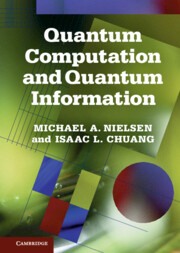
It’s a reference to keep near you on the desk. It misses most recent developments and it’s not a very didactic book, as no 700-pages book aiming to be exhaustive can be. But when you have a doubt or need to check something, that’s the place to go: background + tutorials + Nielsen Chuang is definitely a good starting combo.
Going back to IBM Quantum Experience documentation, after reading it you feel there’s more to say about quantum algorithms and code correction. Regarding the former, there are a lot of resources, especially coming from university courses lecture notes. My experience is that the quality level is heterogeneous and sometimes you find yourself in front of contents copied&pasted (just translated if necessary) from more authoritative sources. That’s why my suggestion is to look at well recognized assets, like the Quantum Algorithm Implementations for Beginners from Los Alamos National Laboratory various authors: https://arxiv.org/abs/1804.03719
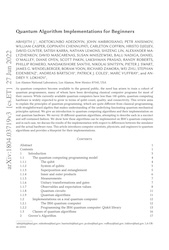
In 2022 it has been advertised on IEEE’s Spectrum and published on ACM Transactions on Quantum Computing. It also has a companion GitHub repo with code implementation: https://github.com/lanl/quantum_algorithms: I think it contains enough stuff to satisfy any thirst of algorithms.
Ok, time to close this first post of the series. Next time we’ll speak about error correction codes and fault tolerance computing. Thanks for reading!